TLDR
- Durability: Blue sapphire rates 9 on the Mohs hardness scale, second only to diamond. It has excellent toughness with no cleavage planes. It is the most practical coloured gemstone choice for a wedding ring worn daily.
- Colour: Colour is the most important quality factor. Look for vivid saturation at a medium to medium-dark tone. The two benchmark colour profiles are cornflower blue (medium, vivid, versatile across all lighting) and royal blue (deep, intensely saturated, associated with Burmese stones).
- Treatment: Most sapphires are heat-treated, a process that is stable, permanent, and entirely appropriate for a wedding ring. Unheated sapphires are rarer and command a significant premium. Full disclosure of treatment status is standard practice.
- Metals: White gold and platinum allow the blue to hold all the visual attention. Yellow gold creates a warm, classic contrast that works particularly well with cornflower blue stones. Rose gold suits lighter, more violet-blue sapphires.
- Settings: Prong settings maximise light and colour visibility. Bezel settings offer the most protection and are strongly recommended for men’s bands and active wearers. Channel settings are the best choice for stacking.
- Men’s bands: Bezel or low-profile prong settings in 6mm to 8mm width. Single-centre stone or half-eternity layout. Platinum and white gold most common, yellow gold a strong traditional alternative.
- Azeera: Every sapphire is hand-selected from the top 1% of available stones and finished in our NYC workshop. Full disclosure of origin and treatment status on every purchase.
Introduction
There is a reason blue sapphire has been placed on the hands of royalty, clergy, and couples for centuries. It carries a depth of colour that no other widely available gemstone matches. It holds that colour in almost any light. And it is hard enough to survive a lifetime of daily wear without the constant anxiety that comes with softer stones. If you’re still deciding which gemstone is right for you, our [complete guide to gemstone wedding rings] covers every option side by side
When Princess Diana received her 12-carat oval blue sapphire ring in 1981, it shifted the conversation around what a wedding ring could be. That ring now sits on Kate Middleton’s finger, still as vivid and intact as the day it was made. That is not a coincidence. That is what sapphire does.
Choosing a blue sapphire wedding ring requires knowing a few things that most jewellers do not take the time to explain. The shade of blue matters more than the carat weight. The origin of the stone affects both its colour and its price. The metal you choose either amplifies or mutes what you paid for. And the style of the setting determines how well it holds up over the years of real life. This guide covers all of it.
Is a Blue Sapphire Durable Enough for a Wedding Ring?
The answer is straightforwardly yes.
Sapphire rates 9 on the Mohs hardness scale. Only diamond, at 10, is harder among gemstones used in jewellery. In practical terms, a sapphire ring will not scratch from contact with everyday surfaces. Metal, wood, fabric, and most materials encountered in daily life all sit well below sapphire on the hardness scale. The only things that can scratch a sapphire are other sapphires, diamonds, and a small number of industrial materials you are unlikely to encounter while wearing a ring.
Beyond hardness, sapphire has excellent toughness. It does not have cleavage planes the way some gemstones do, so a knock against a countertop or doorframe is unlikely to cause damage. This combination of hardness and toughness is why sapphire is consistently recommended as one of the best choices for a ring worn every day.
For comparison, aquamarine and emerald both sit at 7.5 to 8 on the Mohs scale, and emerald has the additional vulnerability of surface-reaching inclusions. Black onyx sits at 6.5 to 7 and is porous. Ruby shares sapphire’s 9 rating. If you want a coloured gemstone wedding ring you never have to worry about, blue sapphire and ruby are the two strongest choices.
Understanding Blue Sapphire Colour
Colour is the single most important quality factor in a blue sapphire. It accounts for between 50 and 70 percent of the stone’s value, and it is what you will notice every time you look at your ring.
Hue
Sapphire comes in a range of blue hues from violet-blue through pure blue to slightly greenish-blue. For wedding rings, pure blue or slightly violet-blue stones are the most desirable. Greenish-blue sapphires can be beautiful and are often more affordable, but they are considered less classic in appearance.
Tone
Tone refers to how light or dark the blue reads. The sweet spot for a wedding ring is medium to medium-dark. Too light and the stone looks washed out, particularly under indoor lighting. Too dark and it reads as nearly black in certain conditions, losing the vivid blue entirely. A useful test: look at the stone under both natural daylight and indoor lighting. A good sapphire holds a clear, rich blue in both environments.
Saturation
Saturation is the richness of the colour. Vivid, highly saturated sapphires command the highest prices and deliver the most striking presence on a ring. When budgeting for a blue sapphire, it is almost always better to choose a slightly smaller stone with excellent saturation than a larger stone with weak or washed-out colour.
Cornflower Blue vs Royal Blue
Two colour profiles you will encounter often. Cornflower blue describes a medium-toned, highly saturated blue with a slight violet character. It is associated with the finest Ceylon sapphires from Sri Lanka and holds its colour beautifully across all lighting conditions. It is the most versatile choice for a wedding ring worn in varied environments.
Royal blue describes a deeper, more intensely saturated blue with a slight violet undertone. It is associated with Burmese sapphires and commands the highest prices in the market. It is spectacular in good lighting but can appear very dark in dim conditions. Neither is objectively superior. The right choice depends on how and where you plan to wear the ring and which shade speaks to you most.
Sapphire Origins: Does It Matter Where the Stone Comes From?
Origin affects colour character, rarity, and price, but it does not determine quality on its own. A fine stone from any origin will outperform a poor stone from a prestigious one.
Ceylon (Sri Lanka)
Ceylon sapphires are the benchmark for blue sapphire quality. Sri Lanka has produced fine sapphires for over two thousand years and continues to yield stones with exceptional colour consistency. Ceylon sapphires typically display the cornflower blue colour profile: medium-toned, vivid, and highly stable across lighting conditions. They are the most common choice for high-quality wedding rings across a range of price points.
Kashmir
Kashmir sapphires are the rarest and most valuable blue sapphires in existence. Mined in the Himalayan mountains in a narrow window in the late 19th and early 20th centuries, they display a velvety, sleepy quality caused by fine inclusions that scatter light inside the stone. The mines are largely exhausted. A certified Kashmir sapphire commands a significant premium purely on the basis of provenance and appears almost exclusively at major auction houses and the highest end of the fine jewellery market.
Burma (Myanmar)
Burmese sapphires produce the deep royal blue colour that many collectors consider the ideal. They are significantly rarer than Ceylon sapphires and priced accordingly. Fine unheated Burmese sapphires are among the most valuable coloured gemstones in the world.
Montana (United States)
Montana sapphires are increasingly popular for couples who prioritise traceable, domestic sourcing. They typically display a steely blue-to-teal colour profile that is distinct from the classic Ceylon look. Montana sapphires are mined in small quantities and offer genuine rarity at accessible price points. Their unique colour range appeals strongly to buyers seeking something personally distinct.
Australia and Thailand
Australian and Thai sapphires tend toward darker, more inky blues. They are generally more affordable than Ceylon stones and can be excellent value when the colour is well-balanced. They are commonly used as accent stones or in rings where deep colour saturation is the primary goal.
Heat Treatment: What It Is and Why It Matters
The majority of blue sapphires on the market have been heat-treated. This is not a shortcoming. Heat treatment is a well-established, broadly accepted practice that improves colour and clarity by replicating the natural geological processes that form sapphires. A heat-treated sapphire with excellent colour is a genuinely beautiful, valuable stone.
Heat-treated sapphires have achieved their improved colour through controlled heating. The treatment is stable, does not fade or degrade over time, and requires no special ongoing care beyond standard gemstone precautions. It is accepted as an industry standard and appropriate for the vast majority of wedding ring buyers at all price points.
Unheated sapphires are those in which no heat enhancement has been applied. They are significantly rarer and, at comparable quality levels, command prices roughly two to five times higher than those of heated equivalents. For serious collectors and buyers prioritising investment value, unheated stones with GIA or Gubelin certification are the benchmark.
At Azeera, every sapphire comes with full disclosure of treatment status. We source from suppliers with documented origin chains and are happy to discuss the specific history of any stone you are considering.
Choosing the Right Shade for Your Skin Tone
This is a practical consideration that most buying guides overlook entirely.
Fair and cool-toned skin tends to complement deep, vivid blues very well. The contrast between pale skin and a rich cornflower or royal blue is striking. Both white gold and platinum settings reinforce this effect. Medium and olive skin tones work particularly well with medium-toned cornflower blues. Yellow gold settings with a medium blue sapphire create warmth and balance that works across a wide range of occasions. Deep and warm skin tones can carry very saturated, intensely coloured sapphires with authority. A deep royal-blue sapphire in a yellow-gold setting against warm skin is one of the most striking combinations in jewellery.
None of these are rules. They are starting points. The best way to assess how a sapphire looks on you is to try it in different lighting conditions, ideally both outdoors and under the indoor lighting you spend most of your time in.
Metal Pairings: Which Metal Works Best With Blue Sapphire?
The metal you choose changes the perceived colour of the sapphire. This is not a minor effect. It is one of the most impactful decisions in the ring design process.
White Gold
White gold is the most popular metal choice for blue sapphire wedding rings. It is neutral, it recedes visually, and it allows the blue of the sapphire to hold all the visual attention. The cool tone of white gold reinforces the stone’s cool blue, creating a cohesive, clean look. White gold requires rhodium plating to maintain its bright white finish, typically every one to two years, depending on wear.
Platinum
Platinum delivers a very similar visual effect to white gold but with practical advantages. It is denser, does not require rhodium replating, and develops a patina over time that many wearers appreciate. It is the premium choice for a blue sapphire wedding ring intended for lifelong daily wear. Despite the higher upfront cost, long-term maintenance costs are lower than white gold.
Yellow Gold
Yellow gold changes the story of a sapphire ring entirely. The warm metal against a cool blue stone creates a contrast that is simultaneously traditional and bold. Historically, yellow gold was the dominant setting metal for sapphires, and many antique and vintage sapphire rings use this combination to spectacular effect. A medium-toned cornflower blue sapphire responds particularly beautifully to yellow gold.
Rose Gold
Rose gold is a more unconventional choice with blue sapphire, but it can produce a striking result with the right stone. The warm, pinkish tones of rose gold create an interesting tension with the blue. It works best with lighter, more violet-blue sapphires. It is not the ideal choice for very deep royal blue sapphires, where the colour interaction can feel unresolved.
Setting Styles: Protection, Presence, and Practicality
The setting determines how secure your sapphire is, how much of it is visible, and how the ring wears over decades.
Prong Setting
A prong setting holds the sapphire with four or six metal claws, allowing maximum light to enter the stone from all angles. It is the setting that showcases the sapphire’s colour most effectively. For a wedding ring worn daily, four-prong settings are generally preferred over six-prong as they reduce the number of catching points on fabric.
Bezel Setting
A bezel setting encircles the entire perimeter of the sapphire in a continuous metal band. It offers the most protection of any setting style, making it the strongest recommendation for active wearers and for men’s wedding bands, where the ring is more likely to encounter impact. The sapphire sits lower to the hand, which also reduces the likelihood of snagging.
Halo Setting
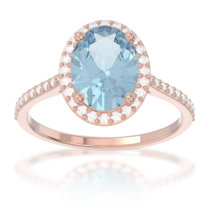
A halo setting surrounds the central sapphire with a ring of smaller diamonds or accent stones. It increases the apparent size of the sapphire and creates a contrast between the vivid blue and the white sparkle of the surrounding stones. One of the most popular engagement ring styles, it adapts well to lower-profile wedding band versions.
Channel Setting
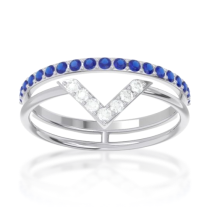
A channel setting embeds a row of sapphires flush within a channel cut into the band itself. There are no prongs and the stones sit level with the metal surface. Channel-set blue sapphire bands are a popular choice for stacking, sitting neatly alongside an engagement ring without competing for attention.
Tension Setting
A tension setting holds the sapphire between two ends of the band using the pressure of the metal itself, with the stone appearing to float in the gap. It is a dramatic, contemporary look that showcases the sapphire’s colour well. Tension settings are best executed in hard metals like platinum and are not appropriate for resizing, which is worth considering before choosing this style.
Blue Sapphire Wedding Rings for Men
Men’s sapphire bands differ from women’s rings in a few specific ways.
Width matters more. A wider band, typically 6mm to 8mm, is proportionally appropriate for most men’s hands and gives the sapphire or sapphires more visual presence on the finger. Protection is a higher priority on average. Bezel settings are strongly preferred for men’s bands because they fully protect the stone from impact during physical activity. Low-profile four-prong settings are an alternative for those who prefer the stone to be more visible.
Men’s blue sapphire wedding bands typically fall into two categories: a single-centre sapphire, often oval or cushion-cut, as the focal point of the band, or a full or half-eternity style with sapphires running along all or part of the band. The single stone option makes a bolder statement. The eternity style is more subtle and works well alongside a more elaborate engagement ring.
Platinum and white gold both work extremely well for men’s sapphire bands. Yellow gold is a strong traditional choice. Many men also favour darker metals, including black rhodium-plated white gold, which creates a striking contrast with a deep blue sapphire. At Azeera, our men’s blue sapphire wedding bands are available in all major metals and can be customised in width, setting style, and stone selection. Every band is made by hand in our NYC workshop.
Blue Sapphire Wedding Rings for Women
For women’s wedding rings, the range of design options is broader, and the key consideration shifts toward how the band interacts with an engagement ring.
Matching vs Complementing
If you have or plan to have a sapphire engagement ring, your wedding band can either match it precisely in stone, cut, and metal, or complement it with a different but harmonious design. A plain platinum or white gold band alongside a sapphire engagement ring is a clean, classic approach. A sapphire eternity band alongside a diamond solitaire is a bolder, more colourful statement.
Band Profile
Comfort-fit bands with a slightly rounded inner edge are significantly more comfortable for all-day wear. If you are choosing a wedding band with channel-set sapphires, confirm that the band uses a comfort-fit profile before finalising the order.
Ring Stacking
Blue sapphire bands stack beautifully with both diamond bands and plain metal bands. A channel-set blue sapphire band between two plain gold bands is one of the most elegant stacking combinations in current jewellery design.
Evaluating Quality: The 4Cs Adapted for Sapphire
While the 4Cs framework was developed for diamonds, a modified version applies well to sapphire evaluation.
Colour (Most Important)
Colour accounts for the majority of a sapphire’s value and visual impact. Look for vivid saturation, a medium to medium-dark tone, and a hue that holds across different lighting conditions. No muddiness, no grey undertone.
Clarity
Unlike diamonds, sapphires are assessed on eye-clean standards rather than microscopic grading. A blue sapphire should have no inclusions visible to the naked eye when viewed from the face-up position. Minor inclusions visible only under magnification are acceptable and common. Heavily included stones that affect transparency or brilliance should be avoided.
Cut
The cut of a sapphire affects how its colour is distributed across the stone. A well-cut sapphire shows an even, rich colour across the entire face, with no large pale areas (windowing) and no black areas (extinction). Oval and cushion cuts are the most popular for blue sapphire wedding rings because they maximise colour retention. Round cuts prioritise brilliance.
Carat
Sapphires are denser than diamonds, so a 1-carat sapphire appears slightly smaller face-up than a 1-carat diamond of the same shape. For a meaningful presence on a wedding ring, stones of 0.75 carats and above are generally recommended. Colour matters far more than carat weight. A 0.8-carat sapphire with outstanding colour will outperform a 1.5-carat stone with mediocre colour in every practical sense.
How to Care for a Blue Sapphire Wedding Ring
Sapphire is low-maintenance compared to most coloured gemstones, but a few consistent practices will keep it looking its best across decades.
Regular Cleaning at Home
Soak the ring in warm water with a few drops of mild dish soap for 10 to 15 minutes. Use a soft toothbrush to gently clean around the setting and under the stone, where dirt accumulates. Rinse thoroughly and pat dry with a lint-free cloth. This can be done weekly without any risk to the stone or setting.
What to Avoid
Avoid harsh chemicals, including bleach, chlorine, and acetone. Remove the ring before using cleaning products and before swimming in chlorinated pools or hot tubs. Avoid ultrasonic cleaners if the sapphire has been fracture-filled, a treatment Azeera does not use. Store the ring separately from softer stones like opals or pearls that the sapphire can scratch.
Professional Inspection
Have the ring professionally inspected and cleaned once a year. The inspection primarily checks that prongs have not worn to the point where the stone risks becoming loose. This is a quick process and typically free or low-cost at the jeweller who made the ring.
Why Choose Azeera for Your Blue Sapphire Wedding Ring
Azeera has been a family business for 75 years. Every ring is cut and set by hand in our New York City workshop.
We source only from the top 1% of available stones. Every sapphire that enters our workshop has been individually evaluated against strict colour, clarity, and cut standards before it reaches you. We do not use stock photography. Every product image on our site shows the actual stone you are purchasing.
Our blue sapphire wedding rings come with a free lifetime warranty covering manufacturing defects and free resizing for the first year. We also offer a free consultation service if you want guidance on stone selection, metal choice, or custom design before placing an order.
Browse our collection of men’s blue sapphire wedding bands and women’s blue sapphire wedding rings, or contact us to begin a custom commission, or read our [complete guide to gemstone wedding rings] if you’re still exploring your options.
Frequently Asked Questions
Is a blue sapphire strong enough to wear every day as a wedding ring?
Yes. Blue sapphire rates 9 on the Mohs hardness scale, making it the second hardest gemstone used in jewellery after diamond. It resists everyday scratches from contact with metal, fabric, and surfaces encountered in normal life. It also has excellent toughness, meaning it holds up well against impact. Sapphire is consistently recommended by gemologists as one of the best choices for daily-wear rings.
What is the difference between cornflower blue and royal blue sapphire?
Cornflower blue describes a medium-toned, highly saturated blue with a slight violet character. It is associated with the finest Ceylon sapphires from Sri Lanka and holds its colour beautifully across all lighting conditions. It is the more versatile choice for a wedding ring worn across varied environments. Royal blue describes a deeper, more intensely saturated blue associated with Burmese sapphires. It makes a dramatic visual statement but can appear very dark in dim conditions. Neither is objectively superior.
Does heat treatment affect the quality of a blue sapphire?
Heat treatment improves colour and clarity by enhancing the natural colour and reducing unwanted inclusions. It is a stable treatment that does not fade or degrade over time and is accepted as standard practice across the gemstone industry. The vast majority of blue sapphires on the market are heat-treated. Unheated sapphires are rarer and command a premium of two to five times or more because their colour was achieved entirely through natural geological processes. For most wedding ring buyers, a well-chosen heat-treated sapphire is an entirely appropriate choice.
Which metal is best for a blue sapphire wedding ring?
White gold and platinum are the most popular choices because they are neutral in colour and allow the blue sapphire to hold all the visual attention. Platinum has the added advantage of not requiring rhodium replating and developing a patina many wearers appreciate over time. Yellow gold creates a warm contrast with the blue stone and suits cornflower blue sapphires particularly well. The best choice depends on which metals you already wear and how you want the ring to look day-to-day.
Can men wear blue sapphire wedding bands?
Absolutely. Blue sapphire is one of the most popular gemstone choices for men’s wedding bands. For men’s rings, bezel settings are generally preferred because they fully protect the stone against impact during physical activity. Wider bands in the 6mm to 8mm range are proportionally suited to most men’s hands. Platinum and white gold are the most common metal choices, though yellow gold is a strong traditional option.
How do I know if a blue sapphire is high quality?
The most reliable indicators are vivid colour that holds across different lighting conditions, no inclusions visible to the naked eye when viewed face-up, and a cut that distributes colour evenly across the stone without large pale or dark areas. Certification from GIA or AGL provides independent verification of quality and treatment status. Every Azeera sapphire is individually assessed by our gemologists before it enters our workshop, and we provide full disclosure of origin and treatment status for every stone we sell.
How much does a blue sapphire wedding ring cost?
Pricing varies based on stone quality, carat weight, origin, treatment status, and setting complexity. A well-cut, heat-treated Ceylon blue sapphire in a clean solitaire setting typically ranges from $800 to $1,500 for stones in the 0.5- to 1-carat range. Premium unheated Ceylon sapphires or stones with documented Kashmir or Burmese origin command significantly higher prices. At Azeera, our rings are priced to reflect the actual quality of the stone. We are happy to discuss options at any budget.
What is the symbolic meaning of a blue sapphire wedding ring?
Blue sapphire has been associated with loyalty, faithfulness, and truth for centuries across Greek, Persian, Buddhist, and Hindu traditions. It is the September birthstone and the traditional gift for both fifth and 45th wedding anniversaries. In the context of a wedding ring, it symbolizes a commitment built on honesty and enduring devotion, which is why it has remained one of the most consistently chosen non-diamond options for wedding jewellery across generations.